


What is the Ludwig scale? The guide to better understand female baldness!
Have you ever noticed your hair falls out more often or your hairline gets thinner?
Then you may have baldness according to the female pattern, also known as alopecia androgenica.
This type of hair loss is common and affects about 50% of women over 50 years of age. But don't worry!
There is a useful tool to determine the severity of your hair loss: The Ludwig Scale.
Other hair scales I have handled on this website are the Norwood scale.
This scale gives the male baldness phases good weather, click on this link voor meer info.
And the different hair types are treated in the Andre Walker scale. Read more here.
What is the Ludwig scale?
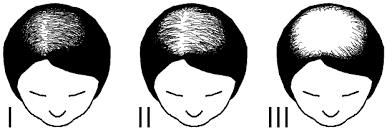
The Ludwig scale is a method to classify female baldness based on the degree of hair loss and the location of the thinning.
The scale ranges from stage 1 to stage 3, with stage 1 being the mildest and stage 3 being the most severe.
The Ludwig scale was developed by dermatologist Dr. Christine Ludwig and is a useful tool for both women and their doctors to understand the severity of hair loss and to determine the best treatment.
Let's go deeper into every stage of the Ludwig scale.
Stage 1: Mild hair loss
At stage 1 of the Ludwig scale there is minimal hair loss and thinning. This stage is characterized by a slight broadening of the part and a slight thinning of the hair on the crown of the head.
At this stage hair loss often does not stand out to others and can easily be masked with hairstyles or hair products.
Women at this stage can notice that their hair is not as thick or full as they used to be, or they can find more hair in their brush or on their pillow.

It is important to detect hair loss at an early stage, because the sooner the diagnosis is made, the more effective the treatment options are likely.
Women in stage 1 can benefit from the use of hair products such as bulky shampoos or styling techniques such as layers or hairstyles to create the illusion of more hair.
Stage 2: Moderate hair thinning
In stage 2 of the Ludwig scale, the hair loss is more noticeable. The separation is wider and the hair on the crown is thinner, with some visible scalp that clears.
Women at this stage may also notice a reduction in the volume of their hair.
This phase may be a bit more difficult to hide, but many women still find it manageable with the right hair products and styling techniques.
Women in phase 2 may benefit from the use of hair growth agents such as minoxidil or cosmetic solutions such as wigs or hair extensions.
They may also consider talking to their doctor about hormonal imbalance or other medical conditions that may contribute to hair loss.
Stage 3: Severe hair loss
In stage 3 of the Ludwig Scale, hair loss is more severe and widespread. The hairline withdraws significantly and large parts of the scalp are visible.
Women at this stage can also experience a noticeable reduction in the thickness of their hair and find it harder to hide the hair loss.
More advanced treatments such as Hair transplants or laser therapy low level.
They can also consider more dramatic hairpieces or wigs and talk to their doctor about any underlying medical conditions that may contribute to hair loss.
It is important to remember that baldness is a common condition in women and that there are many treatment options.
With proper care and attention, women can control their hair loss at any stage of the Ludwig scale and find a solution that works for them.
What's the difference between the norwood and Ludwig scale?
The scale of Norwood and the Ludwig scale are two different classification systems used to assess and categorize the stages of hair loss, especially in male and female baldness, respectively.
Norwood Scale
Target group: Designed primarily for men.
Purpose: Evaluates the progression of male baldness.
Description: The Norwood scale, also known as the Norwood-Hamilton scale, consists of seven main stages (I to VII) and several substages.
It characterizes the typical patterns of hair loss in men ranging from a normal, full hairdo (stage I) to extended baldness with only a hair strip on the sides and back of the scalp (stage VII).
Focus: Emphasizes the receding hairline and baldness on the crown that often occurs with baldness according to the male pattern.
In this Article I go deeper into the Norwood scale.
Ludwig scale
Target group: Mostly aimed at women.
Purpose: Assesss the stages of female baldness.
Description: The Ludwig scale is a three-phase classification system. It focuses on the diffuse thinning of the hair on the crown instead of a descending hairline, which is more typical of male baldness. The three stages range from mild to extensive hair thinning.
Focus: Focuses on the general reduction of hair volume, especially in the central part of the scalp.
Falling hairline in women: A less common but important issue
Although it is less common than in men, women may also suffer from Reverting hairline, the so-called bitemporal recession.
This form of hair loss is characterized by a clear reduction of hair in the hairline, resulting in a thin or thin appearance.

A reversing hairline in women can be caused by several factors, including genetics or underlying medical conditions. However, there are treatment options to restore a full and healthy hairline.
Alopecia traction: Another cause of a declining hairline in women
In addition to bitemporal recession, women may also experience a decline in hairline due to traction alopecia. This type of hair loss is caused by repeated stress and damage to the scalp, usually due to tight hairstyles or hard styling techniques.
To prevent and treat traction alopecia it is important to handle your hair carefully and to avoid tight hairstyles or hard styling techniques.
Women who suffer from a receding hairline due to tractor ealopecia may consider changing their hair routine or style and talking to a hair loss specialist about the best approach.
Although a receding hairline is less common in women than in men, it can be a major problem.
However, with proper care and attention it is possible to maintain and restore a full and healthy hairline.
What are the treatment options for baldness in women?
There are different treatments for baldness in women, both medical and cosmetic. Here are some popular choices:
Medicines: Minoxidil (Rogaine) is a local medicine that has been shown to be effective in treating female baldness. It increases the blood supply to the hair follicles, which can stimulate hair growth.
Wigs and haircuts: Wigs and Haircuts can be a great solution for women who want to hide their hair loss. They come in different styles and can be made from natural or synthetic hair.
Laser therapy: Laser therapy is a newer treatment option that uses low-level laser light to stimulate hair growth. This treatment is non-invasive and has proven effective in some cases of female baldness.
Whatever treatment you choose, it is important to be patient and realistic. Hair loss can be a slow process,





2 reactions
Pingback:
Pingback: