

PCOS and hair loss: What You Should Know 🌱
Hair loss.
If you have PCOS, this word alone can cause a button in your stomach.
Recognizable? You're not alone.
Let's throw the facts on the table and actually talk about wa
What happens, why it happens, and more importantly, what you can do about it.
This video can help in explaining PCOS and hair loss.
Why all of a sudden a lot of hair loss? The PCOS Connection 💔
You probably know: You shower, comb your hair, and suddenly you see picking hair in your brush or drain. Panic!
But wait a minute.
PCOS Hair loss Guide
Evidence-based treatment protocols and scientifically-based therapies for PCOS-related alopecia
Pathophysiology of PCOS Hair loss
Scientific basis of hormonal hair loss mechanisms
Clinical Presentation Patterns
Recognition of different manifestations of PCOS alopecia
Treatment Response Timeline
Expected clinical response patterns and follow-up moments
🎯 Ernst Assessment Tool
Clinical stratification for personalised treatment plan
Early intervention
Combination therapy
Aggressive treatment
Hair loss at PCOS is not a mystery. It has a name: androgenic alopecia.
The culprit? Hormones. Specifically, androgens.
PCOS is characterized by increased levels of androgens, especially testosterone. These hormones cause miniaturization of your hair follicles, which makes your hair thinner and eventually falls out.

But there's more to it:
- Insulin resistance . Yes, this amplifies the situation
- Chronic inflammation . A silent but destructive force
- Genetic engineering . Some of us just draw the shorter straw
And no, you're not crazy if you think stress makes this all worse. It certainly does!
How does hair loss look by PCOS? Recognize the Signals ⚠️
"Is this normal hair loss or PCOS hair loss? '
Goede vraag!
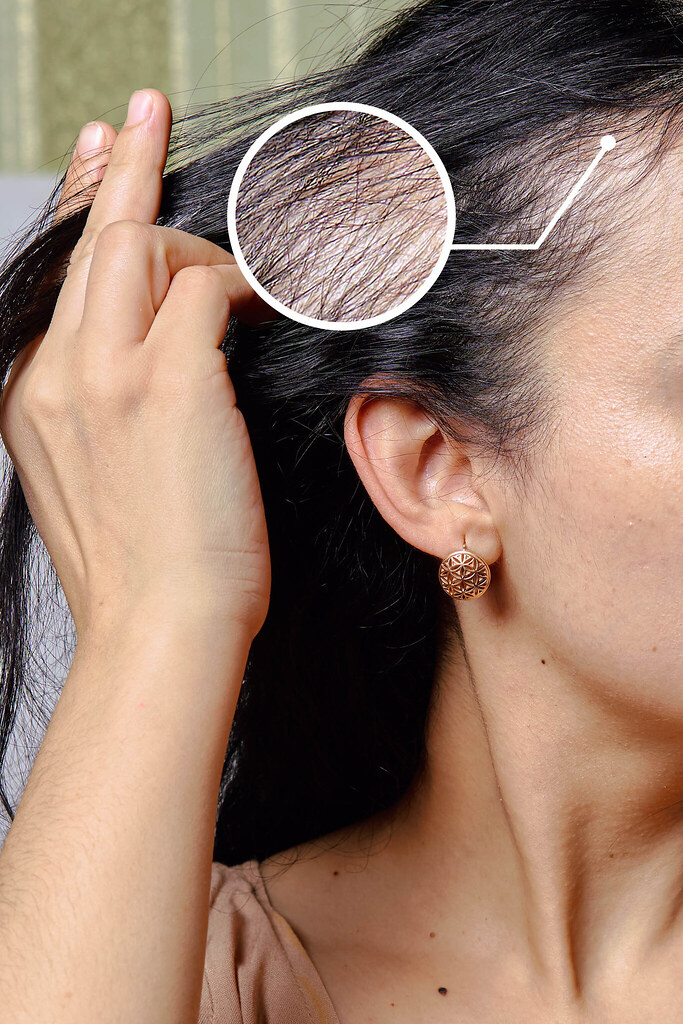
Unlike what you might think, PCOS-related hair loss often presents itself as diffuse dilution over your entire scalp. You probably won't see bald spots, but a general decrease in hair density.
However, in some cases it may resemble male pattern baldness, with dilution in:
- The crown
- The hairline at your forehead
- The separation (which is widening)
Important to know: Not everyone with PCOS experiences hair loss. But if you do, it's crucial to recognize it early.
Is your hair falling out in a way that differs from your normal hair loss? Time to take action.

PCOS Symptoms: More Than Just Hair loss 🔍
Hair loss is never on its own with PCOS.
It's part of a larger pattern. Do you recognize this?
- Irregular menstruation (or none at all)
- Weight gain, especially around your waist
- Acne that won't leave
- Fatigue that coffee cannot solve
- Mood changes you can't explain
- Dark spots in your skin folds
And yes, the irony of PCOS: as your head hair falls out, you might get more hair in places you don't want it (hirsutism).
These symptoms aren't "just bad luck" they're connected by hormonal imbalance.
Anti-Androgens: The PCOS Hair attack Counterattack 💊
Let's talk about solutions. Concrete, proven solutions.
Anti-androgenic drugs like spironolactone are in the scientific spotlight. They work by blocking androgen receptors, slowing the progression of hair loss.
Think of these drugs as a shield:
- They protect your hair bags from the impact of androgens
- They give you existing hair follicles the chance to recover
- They can dramatically delay further hair loss
But a warning: These medicines are not suitable for everyone, and they require prescription and medical guidance.
Another effective weapon: oral contraceptives. Scientific research supports this as a means to regulate hormonal imbalance at PCOS.
The correct contraceptive pill may:
- Decrease testosterone levels
- Stabilise estrogen levels
- Regulating the cycle (bonus!)
PCOS Treatment: The Holistic Approach 🌿
Medicine is one thing. But a holistic approach? That's where real transformation takes place.
1. Nutrition As Medicine
Your plate is more powerful than you think:
- Low-glycemic diet . Stabilizes insulin, reduces androgens
- Anti-inflammatory nutrition . Think: Fat fish, olive oil, turmeric, berries
- Zinc and B vitamins • Essential for healthy hair growth
2. Movement that works with you, not against you
Not all movement is equal:
- Strength training . Improves insulin sensitivity
- Moderate cardio . Reduces inflammation
- Yoga . Decreases cortisol (stress hormone)
Forget HIIT with PCOS . This can sometimes do more harm than good by increasing your stress hormones.
3. Stress Management Is Not Luxury, It's Need
Chronic stress may exacerbate PCOS symptoms. Explore practices such as meditation, breathing exercises or mindfulness to manage stress levels.
Stress and hormones are inextricably linked. Begin small:
- 5 minutes of breathing work per day
- A daily moment of movement in nature
- Setting boundaries in work and relationships
4. Sleep: Your Secret Superpower
Bad sleep = higher androgens. It's as simple as that.
Optimize your sleep with:
- A consistent sleep schedule
- A cool, dark bedroom
- Bedtime limited screen time
Hair loss In PCOS Prevent: Pro-active strategies ⚡
Can you completely prevent hair loss at PCOS?

Maybe not. But you can significantly reduce the risk.
Early Intervention Is Crucial
Scientific evidence suggests that complete reversal may be challenging, but effective management through targeted treatments can slow or stop further hair loss.
In other words: The sooner you intervene, the better.
Topical Treatments With Potential
Minoxidil (Rogaine) deserves a fair chance:
- Available without prescription
- Increases blood flow to scalp
- Can remove hair follicles from the resting phase.
Use it consistently for best results.
Supplements Making the Difference
Not all supplements are the same:
- Saw palmetto . A natural DHT-blocker
- Inositol . Improves insulin sensitivity
- Omega-3 . Reduces inflammation
Quality over quantity. Invest in good brands.
What To Do Against Hair Outage PCOS: Daily Tactics 🛡️
The little things count:
Your scalp: Treat This As Premium Real Estate
- Massage your scalp regularly to stimulate blood circulation
- Use mild, sulphate-free products
- Avoid heat and chemical treatments when possible
Your Styling: Less Is More
- Avoid tight hairstyles pulling your hairroot
- Let your hair dry naturally
- Use protective products if you still use styling tools
Your hair care routine: Consistency Is The Key
Develop a routine and stick to it:
- Do not wash your hair daily (2-3 times a week is ideal)
- Use conditioner, especially on points
- Consider a weekly deep hair mask
Experiences Hair loss PCOS: You're not alone. 💜
The technical part is important. But let's be honest. The emotional impact of hair loss is sometimes the hardest part.
Many women with PCOS report:
- Feelings of shame and reduced self-confidence
- Fear when seeing her in the brush or shower
- Frustration about finding effective treatments
Remember, these emotions are normal. But they don't define you.
Get support from others who understand what you're going through. Online communities, local support groups, or just a friend who listens to this connection helps.
Hair loss by PCOS: The Future Is Hopeful 🔮
Science doesn't stand still. New research fronts offer exciting opportunities:
- Stamceltherapie . Can reactivate inactive hair follicles
- Nutraceuticals . Food-based compounds with promising results
- Microbioma research . The intestinal-hair connection is becoming ever clearer
There is also increasing research into epigenetic factors . . . . how environmental factors influence gene expression in people with PCOS.
What this means: Personalized treatments that take into account your unique situation are getting closer and closer.
PCOS Hair loss Treatment: Your Action Plan 🚀
It is time to bring everything together in a practical action plan:
Step 1: Diagnosis & Monitoring
- Work with a doctor who understands PCOS
- Have your hormone levels tested (testosterone, DHEAS, androstendione)
- Document your hair loss with photocopiers to keep track of changes
Step 2: Addressing The Underlying Causes
- Focus on insulin resistance if this is a problem
- Treat inflammation via food and lifestyle
- Consider medication if necessary
Step 3: Direct Hair Treatment
- Consider topical solutions such as minoxidil
- Study LED light therapy or microneedling
- Invest in quality hair products
Step 4: Maintenance & Prevention
- Stay consistent with your treatment plan
- Adjust your strategy when needed
- Be patient hampered results cost time
The Last Word: Your Hair, Your Travel 💪
The management of PCOS is highly individualized, and what works for one person may differ for another.
This isn't a sprint. This is a marathon.
Some days will be harder than others. There will be moments when you see progress, and moments when you doubt.
But remember this:
Your value is not in your hair.
You're more than your PCOS.
And with the right information, support and dedication, you can manage your hair loss and regain your well-being.
So, what's your first step?
Which PCOS-related hair loss strategies work for you? Share your experiences below Your insights can help someone else struggling with the same challenges!


You might like this too.

Finasteride or Dutasteride? Which one works better against hair loss?
The Complete Guide to Grey Hair: From Voorkommen to Omarmen


