


The Norwood Scale Ontrafeld: Everything you need to know about male baldness
Hair loss. It's a reality that many men face sooner or later. But how do you know exactly what stage you're in? And what does that mean for your treatment options?
Let's dive deeper into the Norwood scale, the most widely used classification system for male baldness patterns. In this blog post, you will not only discover what your Norwood level means, but also what solutions best suit your situation.
This video explains the norwood scale well.
What's the Norwood classification?
The Norwood-Hamilton scale is a standardized classification system developed by Dr. James Hamilton in the 1950s and later expanded by Dr. O. Tar Norwood in 1975. The system is designed to categorize the different stages of male baldness, specifically for alopecia androgenics (also known as male baldness).
Essentially, this scale helps to map the pattern and severity of hair loss, which is crucial to:
- Correct diagnosis of the stage of hair loss
- Identifying suitable treatment options
- Predicting future hair loss patterns
- Clear communication between physician and patient
Think of the Norwood scale as a sort of map of your scalp . It shows not only where you are now, but also what route your hair loss will likely follow.
The different stages of the Norwood scale
Let's look at every stage.
_
Measure your hair loss stage in 60 seconds and discover personal treatment options 🔍
Norwood 1: Are you really bald?
Norwood 1 is characterized by a minimal to no hair loss. The hairline still has the shape of an adolescent, without significant withdrawal at sleep.
Are you Norwood 1 balding? Technically, no. This is the baseline, the reference point by which other stages are compared. If you fall into this category, you have a full hair limit with minimal withdrawal at most.
Still important: even at this stage, subtle changes can occur. Please note:
- Light dunning on the front hairline
- Minimum change in hair density
- Small, hardly noticeable withdrawal at sleep
Norwood 2: The first signs
At Norwood 2, the hairline begins to withdraw, mainly at the temples, resulting in a V-form, M-form or U-form. This pattern is often referred to as a "adult hairline."
Characteristics:
- Symmetric withdrawal at both sleeps
- The hairline at the front usually remains intact
- Withdrawal is limited to a maximum of 2 cm from the original hairline
This stage can remain stable for years or be the beginning of further progress.
Norwood 3: The turning point
Norwood 3 is often seen as the first stage in which hair loss becomes clearly visible. The hairline significantly recedes at sleep, resulting in a deeper M-, U- or V-form. Also light dunning can begin on the crown.
There is also a variant called Norwood 3 Vertex, where:
- The hairline is similar to Norwood 3
- However, there is also significant hair loss on the crown (vertex)
- There remains a bond with hair between the crown and the front hairline
This is a crucial stage because from here onward progress often accelerates.
Norwood 4: Increasing seriousness
In stage 4, hair loss becomes more prominent. The hairline withdraws further than in stage 3, and there is clear baldness on the crown. There is still a clear bond to hair between the front and the crown, but it is thinner than in stage 3.
The challenge here:
- Two clearly bare areas (front and crown)
- The dividing line between these areas begins to fade
- The remaining hair may become thinner
Norwood 5: Connection of bare zones
At Norwood 5, the bald areas of the hairline and the crown begin to converge. The band of hair that separates these zones becomes narrower and thinner.
Characteristic of this stage:
- Larger bare areas both front and crown
- The separation belt is significantly narrowed
- The remaining hair on the sides remains relatively close
Norwood 6: Further enlargement
In stage 6 the bare areas of the hairline and crown are fully connected. The hair on the sides of the head remains present, but the top is largely bald.
This means:
- One large bald area that includes the front and crown
- Hair only stays on the sides of the head
- The remaining hair forms a horseshoe shape
Norwood 7: Most extensive baldness
Norwood 7 is the most advanced stage of male baldness. The only remaining hair is in a narrow band around the back and sides of the head, and even this hair can be thinner than usual.
At this stage:
- Is there a continuous bare area from the front to the back
- Stays the hair alone in a horseshoe shape on the sides
- Is the remaining hair often thinner than in previous stages
Treatment options per Norwood stage
Now that you know what stage you're at, let's look at the treatment options:
For Norwood 1-2:
This is the ideal time for preventive treatments:
- Minoxidil (Rogaine): Stimulates hair follicles and can stimulate hair growth. Available as liquid or foam and is applied directly to the scalp.
- Finasteride (Propecia): An oral drug that blocks DHT (dihydrotestosterone), the hormone responsible for male baldness.
- Lifestyle adjustments: Improved nutrition, stress control and avoidance of hair damage products
Early intervention can slow or even stop further progression!
For Norwood 3-4:
These stages require a more intensive approach:
- Combination therapy: Use Minoxidil and finasteride together for better results.
- PRP treatments: Platelet-Rich Plasma therapy, where platelets from your own blood are injected into the scalp to stimulate hair growth.
- Hair transplantation: At Norwood 3-4 a hair transplant is often an excellent option, especially for the front hairline.
For Norwood 5-6:
At these stages, treatment should be more aggressive:
- Extended hair transplantation: Multiple sessions may be necessary to treat both the hairline and the crown.
- Continue Medication: To prevent further hair loss and to maintain the results of transplantation.
- Hairdressing: For some a high quality hairpiece can be an option
For Norwood 7:
At Norwood 7 hair transplantation the challenge is greater because of the large bald area and the limited availability of donor hair. Options include:
- Strategic hair transplantation: Focus on the most visible areas for maximum cosmetic effect.
- Scale factor optimisation: Techniques such as micro-hair transplantation can help to achieve impressive results with limited donor hair.
- Alternative solutions: Some men choose to embrace their baldness or opt for a shaved look
What does your Norwood classification say about your future?
Your Norwood level isn't just a diagnosis, it's also a predictor. Here are some insights:
Progression speed
The speed with which you go through the Norwood stages can tell a lot:
- Rapid progression: If you go from stage 2 to 4 within a few years, that's a sign that you're likely to experience further progression.
- Slow progression: Staying at the same stage for years may mean that your hair loss is relatively stable
- Age factor: The younger you are at the onset of hair loss, the more likely a faster progression and a higher end stage.
Genetic factors
Look at your family history... the pattern of hair loss in your male relatives, especially on your mother's side, can give clues to your likely path.
Treatment Response
Previous stages (Norwood 1-3) usually respond better to non-surgical treatments such as minoxidil and finasteride. If you are in these stages, you have the advantage that you can intervene before significant hair loss occurs.
Outside the Norwood scale: Other factors to take into account
The Norwood scale is essential, but not the only thing that matters:
Hair quality
The density, thickness and color of your hair affect how visible your hair loss is. Thin, light hair often makes baldness more striking than thick, dark hair at the same Norwood stage.
Head shape
The shape of your skull can have a big impact on what hair loss looks like. Some head forms wear baldness better than others.
Psychological impact
Hair loss is not just a physical problem. It can have a significant emotional impact regardless of the stage. Finding the right treatment option can improve both your appearance and your self-confidence.
Myths over the Norwood scale
Let's correct some misconceptions:
Myth 1: "If no one in your family is bald, neither will you."
Fact: Although genetics plays a major role, male baldness is polygenetic hampered by genes of both parents. You can still develop baldness, even if it's not prominent in your family.
Myth 2: "Balance comes only from your mother's side"
Fact: While the X chromosome (which comes from your mother) plays an important role in male baldness, studies show that genes from both parents contribute.
Myth 3: "Her loss will stop"
Fact: Without treatment, alopecia androgenetics usually progress, although the rate varies per person.
Myth 4: "You cannot change your Norwood stage"
Fact: Early treatment may slow or stop progression, and in some cases even cause an apparent return to an earlier stage by stimulating hair growth.
When do you have to take action?
The right time to take action against hair loss is ZODRA you notice. Here are the signals to watch:
Early warning signals
- Increased hair loss when showering or combing
- Visible changes in your hairline, especially at sleep
- Thinner getting hair on the crown
- Family history of baldness, with similar patterns
The golden rule
Do not wait until it is clearly visible to others. Prevention is more effective than treatment, and early intervention produces the best results.
Waarvoor wordt de Norwood schaal gebruikt?
De Norwood-schaal is een classificatie systeem dat door haaruitvaldeskundigen wordt gebruikt om verschillende stadia van kaalheid bij mannen (MPB) te diagnosticeren. Het bestaat uit 7 hoofdstadia en verschillende substadia. In de afbellding hieronderzijn de verschillende fases duidelijk weergegeven.
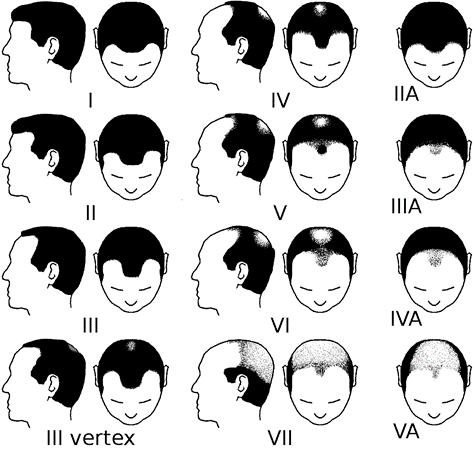
Deze schaal, ook wel de Hamilton-Norwood schaal genoemd, werd voor het eerst ontwikkeld door Dr. James Hamilton in de jaren 1950. De schaal werd later herzien door Dr. O’Tar Norwood in de jaren 1970 en naar deze variant wordt tegenwoordig het meest verwezen. De belangrijkste toevoegingen aan de door Hamilton ontwikkelde schaal waren subsets. Deze bieden variaties in het haaruitvalpatroon, en worden hieronder nader toegelicht.
Examples per norwood phase.
Hoewel zich in de praktijk kleine variaties kunnen voordoen geeft de Norwood schaal een goed beeld van de verschillende stadia van mannelijke kaalhied en haaruitval. Deze schaal wordt wereldwijd gebruikt door professionals op het gebied van haaruitval en staat bekend om zijn nauwkeurigheid. Hieronder staan de 8 stadia van de Norwoord schaal verder uitgewerkt.
Fase 0
Zoals je misschien al hebt gezien staat Fase 0 niet weergegeven op de schaal van Norwoord.
Je zal maar weinig volwassen mannen zien in deze fase. Omdat Norwood 0 betekent dat je geen haarverlies hebt.
Meestal hebben kinderen deze haarlijn. Een goed voorbeeld van deze haarlijn zijn de volgende personen David Schwimmer beter bekend als Ross van Friends, de MMA vechter Khabib Nurmagomedov en acteur Michael B. jordan.


Fase 1
In feite is dit het stadium waarin het haar van de meeste jongens blijft tot hun haarlijn volwassen wordt (meestal in de late tienerjaren en vroege twintiger jaren). Ook wel de volwassen haarlijn genoemd. Meestal bij de meeste mensen is er een heel klein bein van een inham te zien. Het komt zelden voor dat je je hele leven een fase 1 haarlijn behoudt. Degenen met een stadium 1 op de Norwood-schaal hebben nauwelijks tot geen haarverlies. Bekende personen met deze fase van haarverlies zijn Brad pitt en Cristiano Ronaldo.

Fase 2
Tussen de jaren 17 en 30 zal de meerderheid van mannen een vergelijkbaar haarverlies ervaren. In deze fase van de Norwood-schaal beginnen mannen een lichte terugval in hun haarlijn op te merken. Waarbij de haarlijn ongeveer 1 a 1.5 cm op schuift naar achter, waarbij er een soort lichte V vorm onstaat op het voorhoofd. Als je haren je lief zijn kan di alarmerend zijn. Maar het betekent niet per definitie dat er haaruitval op komst is.
In dit stadium wordt zo’n haarlijn niet beschouwd als een teken van mannelijke kaalhied. Dat kan echter snel veranderen als mannen overgaan van stadium 2 naar stadium 2A.
Als jonge mannen hun jonge haarlijn verliezen, ontstaat er een meer volwassen haarlijn. Deze wordt gekenmerkt door een lichte terugval bij de slapen.
Fase 2A wordt door veel haaruitval specialisten beschouwd als het echte begin van haar verlies en laat een duidelijke terugval zien bij de slapen en de voorste haarlijn.
Bij veel mannen begint de V-vorm te verdwijnen deze zal dan langzaam veranderen ineen M vorm.
Goede voorbeelden van Norwood 2 zijn acteurs John Hamm en Leonardo di Caprio.

En van 2A zijn Avengers Captain America en Thor dus zowel Chris Evans als Chirs Hemsworth een goed voorbeeld.

Fase 3
Norwood 3 wordt gezien als het definitieve en eerste punt van haarverlies. Deze fase komt over het algemeen het meeste voor. Op dit punt op de schaal wordt de klassieke M-vorm die bij mannelijke kaalheid hoort duidelijker zichtbaar. Dit is het punt waarop veel mannen hun behandelingsopties serieus beginnen te overwegen.
Samen met de toegenomen terugval van de haarlijn, begint deze klasse van haaruitval ook de vertex (of kruin) van het hoofd aan te tasten.
Ace Ventura aka Jim Carrey, Jackass Johnny knoxville en Conor McGregor zijn perfecte voorbeelden van een deze fase.
In deze fase van haarverlies is het een goed punt is om te starten met drastischere middelen. Denk hierbij aan finasterde of dutaseride or minoxidil in combination with Microneedling. Een haartransplantatie is vanaf dit moment ook een geode optie als dit iets is wat jij overweegt.

Ace Ventura aka Jim Carrey, Jackass Johnny knoxville en Conor McGregor zijn perfecte voorbeelden van een deze fase.
In deze fase van haarverlies is het een goed punt is om te starten met drastischere middelen. Denk hierbij aan finasterde of dutaseride of minoxidil in combinatie met microneedling. Een haartransplantatie is vanaf dit moment ook een geode optie als dit iets is wat jij overweegt.
Fase 4
Het verschil tussen stadium 3 en 4 kan mild maar merkbaar zijn als je weet waar je op moet letten.
Mannen in fase 4 hebben meer terugval bij de slapen. Bovendien kan de strook haar in het midden aan de randen dunner worden. Dit vormt een diepere M-vorm. Daarnaast kann er ook een eiland gaan vormen op de kruin. Althans dit gebied wordt een stuk dunner en daarmee de hoofdhuid zichtbaarder.
De jongere Elon musk is een goed voorbeeld van stadium 4. De terugval in zijn slapen is dieper dan stadium 3, en het dunner worden van de middelste strook is ook duidelijk. Dit is echter voor zijn haar transformatie daarover hier meer.

Fase 5
Bij Fase 4 was er een stuk haar over dat zich tussen de kruin en de voorste haarlijn bevindt. Bij Fase 5 wordt dit stuk haar nog een stuk dunner. Op dit moment is er al dan niet nog een klein stukje haar aanwezig aan de voorkant van de hoofdhuid. Als het nog aanwezig is, is het kleiner geworden en is het haar bij de slapen volledig verdwenen.

In de foto hierboven laat Prince William dit stadium goed zien.
Fase 6
Alleen hele fijne mini haartjes blijven nu over aan de bovenkant van het hoofd.
Tussen stadium 5 en 7, wordt fase 6 gekenmerkt door een samensmelting van de kale plekken aan de voorkant en de kruin. Dit gebeurt als de brug van haar de kruin van de voorkant scheidde verdwijnt.
De acteur Woody Harrilson is een uitstekend voorbeeld van Fase 6 op de Norwood schaal.

Fase 7
Als je Norwood 7 bent, ben je eigenlijk het zakkie als het aankomt op haarverlies De mannen die deze fase in hun leven krijgen beginnen meestal al in hun tiener jaren met haar te verliezen, een stuk eerder dan gemiddeld. Het enige resterende haar is het klassieke hoefijzer haar dat rond de zijkant en achterkant van het hoofd loopt.
Dit is de ernstigste vorm van kaalheid, fase 7, betekent dat het haar op de bovenkant van de hoofdhuid volledig uitvalt.
Dit deel van de hoofdhuid blijft onverminderd dik en is ongevoelig voor kaalheid. Het vormt ook het donorgebied van waaruit chirurgen gezonde follikels transplanteren bij haartransplantaties.
Dr Phil en Bruce willis zijn Norwood 7 voorbeelden.

Wat te doen als jij haar verliest?
Afhankelijk van welke specialist je bezoekt, kan de diagnose van je haarverlies op verschillende manieren worden gesteld.
Een dokter of dermatoloog kan verschillende medische tests uitvoeren. Denk hierbij aan bloed afnames en biopsies. Dit is echter vooral bedoeld ter bevestiging, omdat een getrainde professional meestal met een blik op jou bol het verlies kan vaststellen.
Als jij denkt dat je haar verliest, is het belangrijk hier zo vroeg mogelijk bij te zijn. De best werkende behandelingen die zijn onder andere Minoxidil in combinatie met Microneedling, finasteride of Dutasteride en haar transplantatie . Daarom is de Norwood schaal zo handig, het is goed om te weten waar jij je zich bevindt in jou strijd tegen haarverlies.
Conclusion: Use knowledge as strength
The Norwood scale is more than a classification system . It is a valuable tool that helps you to make informed decisions about your hair. By understanding your own stage, you can:
- Being realistic about your current situation
- Proactive instead of reactive
- Choose the most suitable treatments
- Having better conversations with hair specialists
Remember: Male baldness is extremely common, but that doesn't mean you can't help it. With the right knowledge and interventions at the right time, you can positively influence the course of your hair loss.
Whether you decide to treat or embrace your baldness, understanding your Norwood classification gives you the power to make that choice considered.
Have you figured out your Norwood stage yet? And more importantly, what are you gonna do with it?


11 reactions
Pingback:
Pingback:
Pingback:
Pingback:
Pingback:
Pingback:
Pingback:
Pingback:
Pingback:
Pingback:
Pingback: