

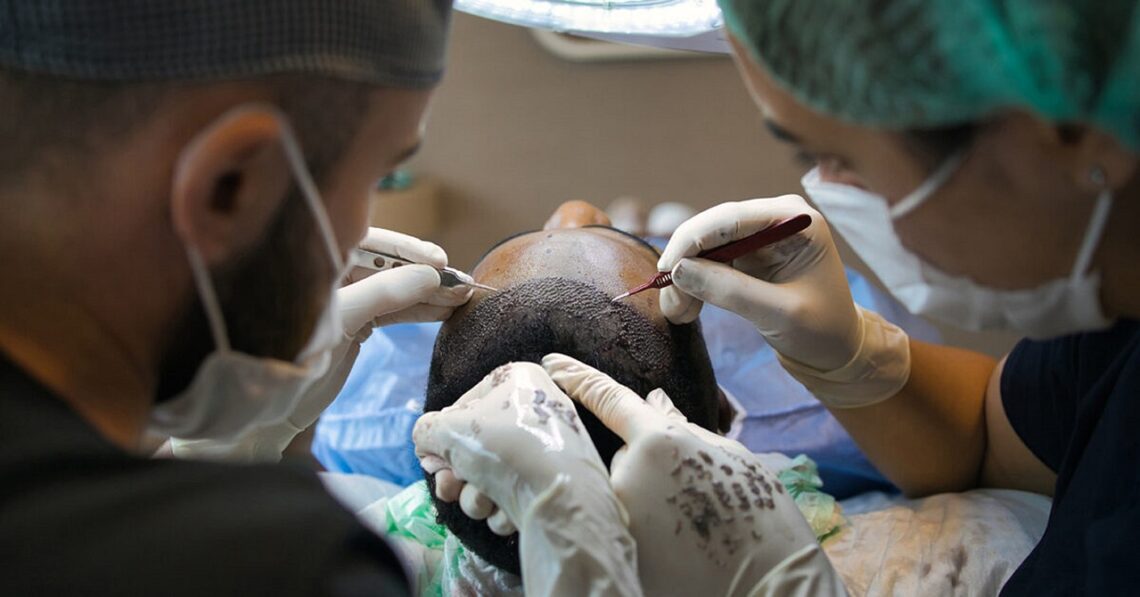
How many grafts do you need? Read all about hair transplants here!
Your hair back.
That's what you want, right?
Let's face it, hair loss gets deeper than just your looks. It's about confidence. About how you see yourself when you look in the mirror.
And if you're here, you're probably considering a hair transplant.
Smart move. 👌
But before you take that leap, you have to understand one crucial concept: grafts.
In this ultimate guide you will discover:
- Exactly what grafts are (and why they are so important)
- How many grafts you need for your specific situation
- What the costs are and how to make smart decisions
- What to expect of the whole process
No sales talk. Only facts that help you make the right choice.
Ready? Let's dive in!
This video clearly explains how many grafts you may need.
What's a graft hair? The building blocks of your new hairline
Let's start with the base.
A graft is a small cluster of hair follicles that is transplanted as one unit.
Think of it this way: A graft is like a mini-apartment complex for your hair. Within one graft, 1-4 hair follicles, each responsible for producing one hair.
Simply put:
- Graft = piece of skin with multiple hair follicles
- Hair follicle = the biological unit that actually produces one hair
This is why the number of grafts and hairs is NOT the same. An important nuance that many clinics "forgotten to mention."
When your doctor says "4000 grafts," this actually means:
- Minimum 4000 hair (if each graft contains 1 hair)
- Not more than 16,000 hairs (if each graft contains 4 hairs)
Usually you're somewhere in the middle: one graft contains an average of 2-3 hairs.
Reality check: At 3000 grafts you get an average of 6000-9000 individual hairs.
Hair transplantation Calculator
📊 Your treatment plan
💡 Personal Advice:
–
How many grafts do I need? This determines your number
The question that everyone asks: "How many grafts do I need?"
The honest answer? It depends on your particular situation.
But I'm not going to dismiss you with such a vague answer. Let's make it concrete.
The Norwood scale: Your personal hair loss roadmap
The Norwood scale is the standard for classifying male hair loss. It runs from Stage 1 (minimum loss) to Stage 7 (extensive loss).
Here's how many grafts you need on average per stage:
Stage 2: Slight withdrawal at the hairline
- Grafts required: 600-800
- Treatment time: 3-4 hours
- Recovery period: Fastest of all stages
Stage 3: Significant withdrawal at sleep
- Grafts required: 1000-1500
- Treatment time: 4-6 hours
- Price in the Netherlands: €2500-€6000
Stage 4: More pronounced hair loss with thin crown
- Grafts required: 1500-2000
- Treatment time: 6-8 hours
- Price in the Netherlands: €4000-€8000
Stage 5: Larger bald area, with a "bridge" of hair that separates crown baldness from frontal baldness
- Grafts required: 2000-2500
- Price in the Netherlands: €6000-€10.000
Stage 6 & 7: Extensive baldness
- Grafts required: 3000-5000+
- Reality check: Multiple sessions are often required
- Price in the Netherlands: €9000-€15.000+
How many grunts do you need for crown? The numbers no one tells you
The crown deserves special attention.
Why? Because it's a larger surface than the front of your hairline.
For a bald crown you have typical 1800-2500 grafts necessary for a natural result. But this varies depending on:
- The size of your bald area
- The desired density
- Availability of your donor zone
Pro tip: A crown doesn't need the same density as your hairline. Nature also works as a crown has a lower density of hair.
How many grafts tops? There is a limit (and that is good news)
Here comes a hard truth: You can't have infinite grafts transplanted.
Why? Because your donor area (the area at the back and side of your head where the grafts come from) is limited.
Most men have up to so many 6000-8000 grafts available in their entire lives.
This means two things:
- Deal wisely with your donor stock It's a finite source
- Be realistic about results A full bunch of hair is not feasible for everyone
Strategic thinking is key: Some doctors will lure you with "5000 grafts in one session!"
Red flag. 🚩
You risk donor exhaustion and suboptimal results. A responsible clinic thinks about your long-term plan.
Hair transplantation Guide
Everything you need to know about hair transplantation in the Netherlands
📊 Facts & Figures
🔄 The Treatment Process
📅 Restore Timeline
Day 1-3: Immediately after treatment
Slight swelling and sensitivity. Wash carefully and follow care.
Week 1-2: Crust phase
Small crusts around transplant zone. These, of course, fall off.
Month 2-4: Shock loss
Transplanted hair is temporarily falling out. This is normal and expected.
Month 4-6: New growth
First new hair growth becomes visible. Still thin and fragile.
Month 8-12: Thickness
Hair gets thicker and stronger. Clear improvement visible.
Month 12-18: Final result
Complete end result achieved. Maximum density and thickness.
📏 Norwood Scale
Classification of male hair loss
💰 Cost Overview
💡 Important Tips
⚠️ Important Warning
Be careful with hair tourism trips abroad. Always check the qualifications of the clinic and doctor. Cheap can be expensive in case of complications. Dutch clinics offer better aftercare and are easier to reach in case of problems.
2000 Grafts: What can you do with it?
2000 grafts is a popular number for first treatments. But what can it actually achieve?
With 2000 grafts you can:
- Restore a full hairline
- OR compact a thin crown
- OR a combination with light density in both areas
Visualize it like this:
- 2000 grafts = 4000-6000 individual hair
- Spread over a hairline (±10 cm2) = good density
- Spread over hairline and crown (±25 cm2) = visible improvement but less dense
Treatment time: About 6-8 hours, usually in one day Recovery period: 7-10 days for the most visible signs of the procedure Result visible: 12-18 months for full effect
How many hairs are 3,000 grafts? What about 5,000 grafts?
Let's take the exact figures:
3000 grafts:
- On average, 2 hairs per graft: 6000 hairs
- On average 2.5 hairs per graft: 7500 hairs
- On average, 3 hairs per graft: 9000 hair
5000 grafts:
- On average, 2 hairs per graft: 10,000 hairs
- On average 2.5 hairs per graft: 12,500 hair
- On average, 3 hairs per graft: 15,000 hairs
Reality check: Most men with natural hair have about 100-120 hairs per square inch. With transplants you usually aim at 40-60 hairs per cm2. That's less than natural, but enough for a voluminous look.
How many grafts for completely bald? The hard truth
Being completely bare usually means Norwood 6 or 7, which is a significant surface.
For a full treatment you have about 4000-6000 grafts necessary.
You have to take this into account:
- This often requires multiple treatments
- Your donor area must have sufficient capacity
- A single-session treatment of this format is risky for your grafts
Reality check: For completely bald men, the goal is often not to fill every square inch, but to create a natural-looking distribution that dramatically improves your situation.
Cost of hair transplantation: The price tags in a row
The Dutch want to know where they stand. No hidden charges. No surprises.
Here are average prices in the Netherlands:
1000 grafts: €2000-€3500 2000 Grafts: €4000-€7000 3000 grafts: €6000-€10.500 4000 grafts: €8000-€14.000 5000 grafts: €10.000-€17.500
Important nuance: The price per graft usually drops as you get more grafts done. A clinic that €3 per graft calculated, at 5000 grafts often will not €15,000 questions, but applying a raffle discount.
How much is 5000 grunts exactly?
For 5000 grafts in the Netherlands you pay on average between €10,000 and €17,500.
But price differences have reasons:
- Experience of the surgeon (more important than you think)
- Technique (FUE is more expensive than FUT)
- Team (how many specialists work on your treatment)
- Location (Amsterdam is more expensive than Eindhoven)
Pro tip: Cheap is expensive for hair transplants. Focus on quality and results instead of just the price.
Hair transplant Netherlands: What makes us unique?
In the Netherlands we have strict medical regulations. That's your advantage.
Dutch clinics offer:
- Regulated care according to European standards
- Detailed consultations before treatment (a must!)
- Transparent price structures without hidden costs
- Aftercare which is often included in the price
The Dutch approach: Quality over quantity. Realistic expectations. Fair advice.
Many foreign clinics (yes, especially in Turkey) attract with low prices and promises of "maximum grafts."
Dutch doctors will tell you more when you are not a candidate for a transplant. And that's exactly what you want to hear when it's true.
The hair transplantation process: What can you expect?
A hair transplant is not a lunch break treatment. It's a surgical procedure that requires precision.
Here's what to expect:
- Consultation: Analysis of your hair loss, donor area and expectations
- Preparation: Your hair is cut short, the donor area is marked
- Extraction: Grafts are carefully extracted from the donor area (FUE or FUT)
- Preparation of grafts: Each graft is checked under a microscope
- Make incisions: Tiny receiving channels are created in the bare area
- Placement: Graphs are placed one by one according to a natural pattern
- Aftercare: Instructions for the first days and weeks
Voor 4000 grafts takes this process about 8-10 hours. Yeah, long day. But one day for years of confidence is a good deal, right?
The ultimate checklist: Determine your perfect number of grafts
Let's make it personal. Here's how you can estimate how many grafts you need:
- Determine your Norwood level (use online reference images)
- Measure your bald area (crude estimation in square centimeters)
- Determine your desired density (light, medium, closed)
- Check your donor capacity (fine and dense hair = more potential grafts)
Quick calculation:
- Kale area (cm2) x Desired density (hairs per cm2) = Required hair
- Required hair Average number of hairs per graft (2-3) = Required grafts
Example: 20 cm2 x 40 hairs/cm2 = 800 hairs and 2.5 hairs per graft = 320 grafts
The real value of a hair transplant
A hair transplant isn't just about her.
It's about how you feel every time you look in the mirror. It's about not having to think about how to style your hair to hide baldness. It's about recognizing yourself.
Is that measurable in grafts or euros? Hard.
But ask someone who did it, and you almost always get the same answer: "I should have done it sooner."
Conclusion: Your next steps
The number of grafts you need is personal. Your hair loss, goals and budget determine what works best for you.
But know this:
- A good clinic gives honest advice, no sales reps
- Results depend more on placement than numbers
- Your donor area is precious . . use wisely
Ready for the next step? Make an appointment for a consultation at a specialized clinic.
And remember: You don't have to make any decisions during that first conversation. Take your time. Compare. Ask questions.
Your hair deserves the best. And so are you.
Do you have any questions about your particular situation? Leave a comment or contact us directly. We'd be happy to help you on your journey to a fuller hairdo.


I've written several articles about hair transplants, are you interested in this? Then I suggest you click on one of the blogs below!
Why do people still lose their hair after a hair transplant?
10 Things you should not do after a hair transplant!
Which hair transplant is better for you? FUE or FUT
When will you no longer qualify for a hair transplant?
What's the best place in the world for a hair transplant?
The DHI hair transplant: A revolutionary hair repair technique?
Kunnen vrouwen ook een haartransplantatie ondergaan?
The truth about side effects hair transplantation: crucial information you should not miss!
What is a graft and how is it made? All about hair transplants!
Is it time for a hair transplant and how do you prepare for this?
Is a hair transplant without taking Finasteride useless?


You might like this too.

Is the cause of your hair loss a fungal infection? Read more here!
Does using Anavar cause hair loss?


