Is Verteporfin de potentiële oplossing tegen haaruitval?
The search for effective solutions to hair loss has led to innovative research, in which Verteporfin emerged as a candidate for hair recovery.
The Verteporfin research for hair loss represents an exciting pioneer phase in the field of hair recovery.
Although early findings suggest promising results in mice, translation to human applications requires careful research.
In this extensive blog we're diving into what Verteporfin is, the underlying theories that support its potential effectiveness, how it can be obtained, and the current state of research in this exciting domain.
What's Verteporfin?
Verteporfin is a photosensitising agent used primarily in photodynamic therapy to treat certain eye conditions, such as age-related macular degeneration. Recently researchers have explored their possible applications outside of ophthalmology, especially in the area of hair loss.
The Theoretical Base: How can Verteporfin deal with hair loss?
The theoretical basis for the potential effectiveness of Verteporfin in the treatment of hair loss lies in its interaction with a signal route known as YAP/TAZ. These routes play a role in regulating cell proliferation, differentiation and tissue homeostasis. By inhibiting YAP/TAZ activity, Verteporfin may influence the hair follicle cycle and thus stimulate hair growth.
What does the investigation say?
The potential use of Verteporfin in hair loss treatment results from research studies, in particular a published study in the International Journal of Molecular Sciences in 2021. In this study researchers investigated the effects of Verteporfin on hair growth using a mouse model. The main findings include:
Increase in hair follicle size
The study observed an increase in the size of hair follicles in mice treated with Verteporfin. This is a crucial indicator as larger hair follicles are generally associated with healthier and more powerful hair growth.
Improved Density of Hair follicles
Another remarkable result was the increased density of hair follicles. This suggests that Verteporfin can play a role in promoting the proliferation or activation of hair follicles, contributing to improved hair density.
Inhibition of the YAP/TAZ Signal Route
The study suggested that Verteporfin exerts its effects by inhibiting the YAP/TAZ signal route. YAP and TAZ are transcription factors involved in regulating cellular processes, and their inhibition may affect the hair follicle cycle and possibly promote hair growth.
Although these findings are promising, it is important to note that the study has been performed on mice, and extrapolating these results to humans requires further research, including well-designed clinical trials.
2. Theoretical Base: YAP/TAZ Signal Route:
- Normal hair growth cycle: The hair growth cycle includes phases of growth (anagene), regression (catagene) and rest (telogen). Disruptions in this cycle, such as premature entry to the teal phase, can lead to hair loss.
- Role of YAP/TAZ: The YAP/TAZ signal route is known to affect tissue regeneration and homeostasis. In the case of hair follicles, activated YAP/TAZ is associated with maintaining the anagenic phase and preventing premature entry into the tealous phase.
- Mechanism of Verteporfin: Verteporfin is supposed to inhibit the YAP/TAZ signal route. This allows intervention in the regulatory mechanisms affecting the hair growth cycle. The inhibition of YAP/TAZ might prolong the anagenic phase and stimulate a conducive environment for hair growth.
Future Implications and Considerations
Although Verteporfin's preliminary findings and theoretical bases for the treatment of hair loss are intriguing, several considerations should be taken into account:
- Clinical Trials in People: The transition from mouse studies to human applications requires well-designed clinical trials. Human testing will provide essential data on safety, effectiveness and possible side effects of Verteporfin for hair loss in various populations.
- Optimum Formulating and Dosage: To determine the most effective formulation and dosage of Verteporfin for the treatment of hair loss requires further examination. The concentration and method of administration are likely to affect the results.
- Long Term Effects: Assessing Verteporfin's long-term effects and sustainability as a treatment for hair loss is crucial. Understanding how effects can develop over longer periods will be essential to clinical acceptance.
Breakthrough results with Verteporfin Tasting
Dr. Barghouthi recently shared the results of his four-month trials on the Verteporfin hair recovery network forums, and the results are truly remarkable.
His experiments included injecting the drug immediately after Follicular Unit Extraction (FUE) and Follicular Unit Transplantation (FUT) surgery, using his apparent ability to heal scars and promote hair growth from the donor region. The goal is to create some sort of .. ..infinite donor disregarded.
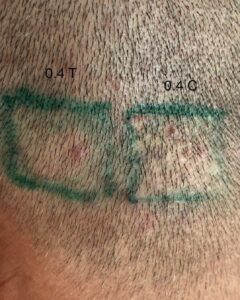
Preliminary results of the publicly funded study show a marked contrast between the control group and the treated group.
In his own words he says: "The zoomed area of 0.4 seems unto me untouched." Based on initial observations, most of the donor area appears to have grown back.
Although it is essential not to go too far ahead, its implications are monumental! This should become commonplace; It's incredible.
The new hair growth is clearly visible at the moment, but the crucial question remains: How many grafts are reclaimed? Is it 30%, 50%, or even 70%? Even a regeneration rate of 30% is extraordinary, and anything above 50% could be considered an effective cure.
Further tests are expected to refine the percentage. The question now is, how long does Verteporfin take to become a standard practice in transplants? Hopefully at the end of 2024 we will see 5-10 doctors implementing it. I'll wait until then.
How can Verteporfin be administered?
Although Verteporfin FDA has been approved for ophthalmic use, its application for the treatment of hair loss is research-based and not yet generally recognised. For those who want to explore this path, it is crucial to approach Verteporfin administration under the guidance of health professionals participating in research studies or clinical trials.
FAQs
Q1: Is Verteporfin directly available to treat hair loss?
A: Verteporfin is currently not approved for the treatment of hair loss. Access to Verteporfin for this purpose may be restricted to participation in research studies or clinical trials.
Q2: Are there any side effects associated with Verteporfin?
A: Verteporfin, when used for its approved indications, is generally well tolerated. However, the potential adverse reactions in the context of hair loss treatment are not fully understood and require further investigation.
Q3: When can we expect Verteporfin to become an approved treatment for hair loss?
A: The timeline for accepting Verteporfin as mainstream treatment for hair loss is uncertain. Continuous research and successful clinical trials will play a crucial role in determining their viability.
Conclusion
In the ever changing landscape of hair loss treatments, Verteporfin emerged as a fascinating contender, with promising findings from preliminary research. However, it is crucial to approach this potential breakthrough with a measured perspective.
As research progresses and more data become available, Verteporfin's role in the treatment of hair loss can become clearer. For those who are intrigued by Verteporfin's capabilities, participation in clinical trials or studies by renowned health professionals is the safest and most ethical approach.
Consultation with dermatologists or hair loss specialists will provide valuable insights into the evolving field of hair recovery and guide individuals to evidence-based choices.
Although Verteporfin's journey from photosensitising agent to hair loss treatment is in its infancy, its potential glows up optimism for a future in which innovative solutions redefine our approach to maintaining a full and vibrant hairdo.
As research progresses, clinical trials in humans will reveal Verteporfin's true potential and limitations as treatment for hair loss. For individuals who are intrigued by this potential breakthrough, patience and an informed approach will be crucial while the scientific community continues to unravel Verteporfin's mysteries in its field.
It is important to note that the translation of findings from animal studies into human applications is a complex process and requires extensive clinical trials to determine safety and effectiveness.


You might like this too.

Does honey help as a natural remedy to baldness or hair loss?

Can Finasteride cause depression?